

As someone who generally stays on the Apple side of the fence, it’s rare these days that I see an Android phone that truly piques my interest.
The first was the HTC One from 2013. With its metal body and beautiful hardware and software design, it was the first Android phone I looked at and thought, “An actual designer was involved with this.”
The next was the Nexus 6, which featured a “massive” 6-inch OLED display at the time. Fun fact: the display unit at AT&T was the first time I’d seen OLED screen burn-in.
Lastly, there was the Surface Duo, which, until recently, was my absolute favorite foldable. I think Microsoft got so much right with this form factor, and it’s a shame they weren’t willing to commit to it, nor has anyone else copied it.
This brings us to my latest acquisition: the Samsung Galaxy Z Fold 8.
Breathtaking Hardware
I wanted to write about the Z Fold 8 until the initial honeymoon period had worn off because I think much of the enthusiasm for this device stems from novelty.

It’s been fun carrying a device that is, most of the time, significantly smaller than the devices we’ve all become accustomed to. It feels like a throwback to a more quaint era, before phones started encroaching on the size of laptop displays.
Opening this phone up feels amazing. The Fold 8 being both thinner and lighter than the upcoming iPhone Duo and that’s something Samsung engineers should be proud of.

That being said, I do think the passport-sized dimensions for a phone feel refreshingly delightful. Being wider means the phone isn’t truly one-handable, but at only 5.5 inches, the cover screen feels quite manageable in the hand. I’m a bit of a weirdo who thinks having a phone-sized outer display makes it easy for people to ignore the inner screen, which, you know, feels like it runs counter to the whole point of a folding phone. But even I was convinced by how nice the cover screen is to use. And unlike the inner screen, I didn’t run into any layout or compatibility issues with apps on this display.
There is, however, is a big tradeoff with the Z Fold 8: the thickness. Samsung has gone to great lengths to make this phone as thin as possible, but unfortunately, it’s still not quite there. At 9.9 mm when closed, the Fold 8 is about the same thickness as the iPhone 4 from 2010. Maybe I’ve been spoiled by the iPhone Air, but a phone that thick is unacceptable in 2026, especially for the price Samsung is asking for this device. It feels heavy in my pants pocket, and the square edges make it an awkward overall fit. I appreciate that Samsung at least managed to somewhat round the hinge corners. My Surface Duo actually managed to wear a hole in my jeans pocket because its hinge corners were so sharp.
Another hardware issue I didn’t foresee annoying me was the camera bump. A wobbly phone isn’t something most people solve with a case. On the iPhone, it’s been a very minor annoyance. But on the Fold 8, the camera bump is so pronounced, when the phone is closed on my desk, its almost unusable, and I don’t think I’m being that dramatic.
Now, my favorite aspect of the hardware is neither the screens, the cameras, nor even the overall size of the device itself.
It’s the hinge. I 100% bought this phone entirely because of the hinge.

The hinge really sells the “book” design of this foldable, and I can’t stop picking it up and running my finger over it. I’ll probably end up wearing down the Samsung logo. It helps that the metal covering contributes to the whole package feeling premium.
The inner display is where my expectations didn’t really align with reality. The 7.6-inch “creaseless” screen has a 4:3 aspect ratio that, in theory, should feel like the iPad Mini. Except it doesn’t, in both good and bad ways.
As for the crease, it’s not something you see when looking at the larger display head-on. Tilt the phone slightly off-angle, and you see it. It’s minimal, but it’s there. Not a big deal. The only slight annoyance with the crease is that you still feel it when performing swipe gestures. It ever so slightly detracts from the device’s premium feel, but I don’t want to overstate this; it’s a very minor thing.
As an iPad-first user, even I can’t help but notice how modern the Z Fold 8 feels as an Android tablet. It shines a big spotlight on how behind the times the current iPad Mini hardware is. For years, some in the iPad community (myself included) argued that the large bezels on modern iPads were fine, even desirable, because they provided a surface to hold onto that wasn’t the screen. The Z Fold 8 proves us wrong, folks. I had no issues with mis-taps or fingers covering content with this large screen.

I have found it most comfortable to use the inner display in portrait orientation and rest my thumbs on the hinges themselves. Portrait orientation is always my refuge if I encounter an issue with an app on the inner display. For me, the app was Microsoft Teams, but I encountered a weird layout issue in landscape where a notification showed up off-screen, and I couldn’t answer a call until I rotated the device. I have heard others have had more app layout issues with the inner display, given that the aspect ratio is uncommon for a phone.
One feature I barely used on the inner display was split-view multitasking. Android has had this on standard portrait phones for years, and it has always felt a little strange to me. Two tiny slivers of an app stacked on top of each other never made much sense. On a foldable, it is obviously a better experience.
Multitasking is only available on the inner display in landscape, and it works like you’d expect. Drag an app to either side, and boom, you have Split View. Thanks to the inherent flexibility of Android apps, you are allowed to resize them by dragging the slider.
However, In using the Fold 8, I’ve realized that multitasking on a phone isn’t something I actually want to do. My phone is the tool for when I have one hand free or a single task, like checking social media or email. That means I either used the cover screen or the inner screen in portrait orientation. In both scenarios, you can only have a single app open, and that worked well for me.
Honestly, my biggest use for the inner display was scrolling social media, Threads specifically. Samsung’s marketing for the Z Fold 8 seems to align with my use case. Indeed, Samsung highlights how well scrolling social feeds works on the inner display, particularly in portrait. The taller Z Fold 8 Ultra is positioned as the device for serious productivity, whereas the Z Fold 8 is more of a fun, everyday device. And you know what? There’s nothing wrong with that.
Samsung’s Android is Good
I’ve been a phone enthusiast long enough that when I think of a Samsung phone, I think “TouchWiz.” I’m happy to say that One UI is definitely not TouchWiz.
One UI feels significantly more refined, as if, at some point in the past decade, Samsung started taking software design seriously. Truth be told, I like One UI much more than Material You on Google’s Pixel phones, which looks blobby and unfinished.
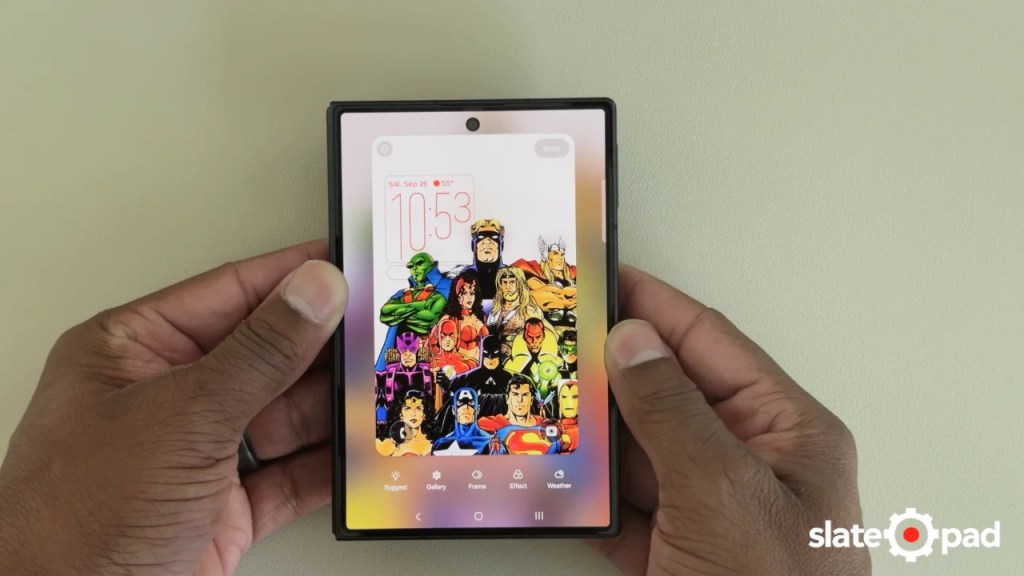
One of my favorite One UI features is the lock screen design. Samsung clearly spent a lot of time on this. The clock intelligently adapts to the content of your lock screen photo. You can even use (presumably on-device) AI to generate different crops and positioning for your lock screen.
On Android, I use a mix of both Samsung’s and Google’s apps. Nothing too crazy here, mostly apps like GMail, YouTube, Google Maps on the Google side, and apps like Voice Record, My Files, and of course the Camera app on the Samsung side. Pretty much every Android review I’ve read treats anything that isn’t a Google app as bloatware, but again, I think Samsung has seriously stepped up their software game in recent years.
My time back on Android has also reminded me of some of the nice little touches that I’ve always liked about the platform. After all this time, it’s great that pattern lock is still a thing. It’s just fun and I like it.
In some ways, the Fold 8 reminds me of the Nexus 7, which was one of the few truly great Android tablets. Between the amazing hardware and the thoughtful design of Samsung’s take on Android, the inner screen feels like the tablet experience I wanted the Pixel Tablet to have. I might even go as far as saying this is the best Android tablet experience I’ve had since the Nexus 7.
Despite the nice things I said about Android, I’m writing this review in the wake of the iPhone Duo announcement, and its hard look at the Fold’s software a little differently. I don’t really see the same kind of small touches that Apple has shown with iOS on their passport foldable. These are the types of things that make Android on the Fold 8 feel just okay, but iOS on the iPhone Duo feel special.
Thanks to my iPad Pro, my phone use is pretty minimal, to the point where Android vs. iOS really doesn’t make a difference. There are certain aspects of Android I really like, such as the flexibility of the home screen layouts, but overall, it doesn’t feel drastically different from any of my iOS or iPadOS devices.
Paying Laptop Money for a Phone
The Galaxy Z Fold 8 costs $1900 USD for the base model with 256 GB of storage. That price point will keep this phone, and book-style foldables in general, as niche products in the overall smartphone market. I managed to make this work thanks to a combination of Best Buy pre-order incentives and a generous trade-in offer, bringing the cost to about $1200 after all was said and done, which feels like the right price for something like this. I don’t love the idea of people paying MacBook Pro-level money for a phone, even one as swanky as this.
I’m told that, unlike Apple, it’s not uncommon for Samsung to actually discount their phones throughout the year, especially as new models approach. I don’t think this phone is worth its asking price, and my recommendation is to wait for a sale.
Conclusion

The Galaxy Z Fold 8 was in no way a necessary purchase for me, but I have no regrets. This is an amazing device. It stands as a reminder to some of us deep in the Apple ecosystem that it’s not just the folks in Cupertino who know how to make great products, and that’s exactly what Samsung did here.
I didn’t expect to feel somewhat disappointed by the plastic feel of the inner display, but if that’s the worst thing I have to say about this device, I think Samsung did pretty well.
Leave a Reply